
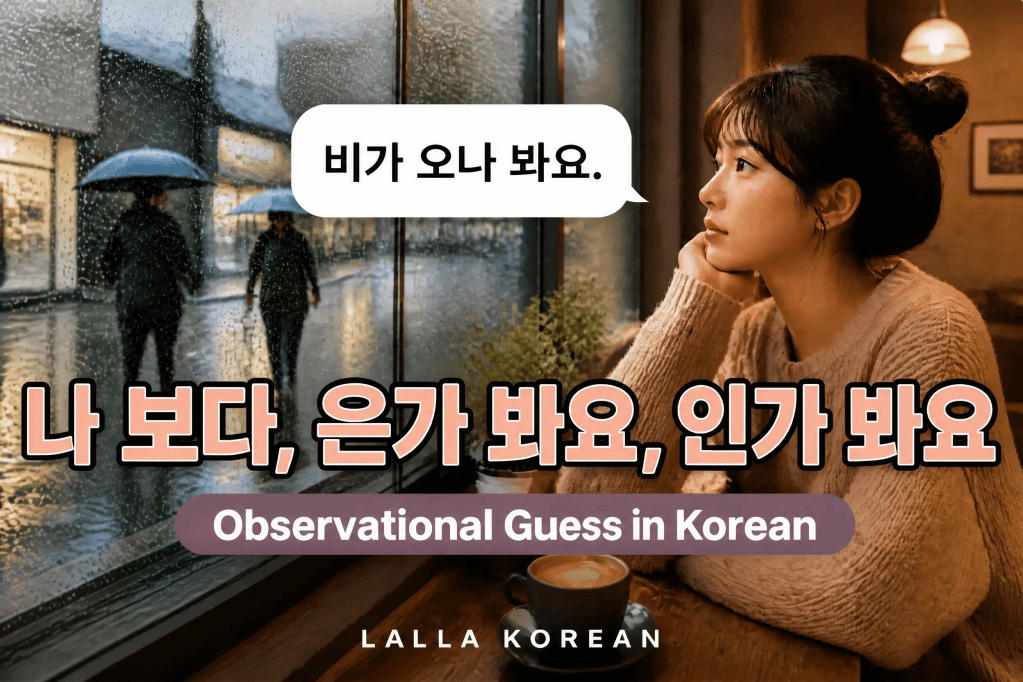
🎵 Start with this song!
“아무래도 사랑인가 봐“
“It must be love, no matter how I look at it”
Have you ever looked at a situation and thought — “Something must be going on here”?
Maybe someone keeps yawning, so you think: They must be tired.
Maybe your friend hasn’t replied all day, so you think: They must be busy.
In Korean, there’s a beautiful grammar pattern for exactly this feeling. 😊
What Does -나 보다 / -은가 보다 / -인가 보다 Mean?
This pattern expresses an observational guess — a conclusion you draw from something you see, hear, or feel around you.
In English, it’s closest to:
“It seems like…” / “I guess…” / “They must be…”
The key is: you’re not just imagining — you have evidence right in front of you.
💡 It carries a slight sense of surprise or fresh discovery, as if you’re figuring something out in real time.
Conjugation
| Part of Speech | Form | Example |
|---|---|---|
| Verb (present) | -나 보다 | 자나 보다 / 바쁘나 보다 |
| Adjective (present) | -(으)ㄴ가 보다 | 피곤하ㄴ가 보다 / 좋은가 보다 |
| Noun + 이다 | -인가 보다 | 학생인가 보다 / 사랑인가 보다 ⭐ |
| Verb/Adjective (past) | -았/었나 보다 | 힘들었나 보다 / 먹었나 보다 |
💡The spoken form -나 봐 /-(으)ㄴ가 봐/ -인가 봐 is very common in everyday Korean.
More Example Sentences
This is the heart of the pattern. You notice something → you draw a conclusion.
밖에 우산이 많네. 비가 오나 봐.
There are a lot of umbrellas outside. It must be raining.
전화를 안 받아. 자나 봐.
They’re not picking up. They must be asleep.
얼굴이 빨개. 부끄러운가 봐.
Their face is red. They must be embarrassed.
밥을 또 먹어? 많이 배고팠나 봐.
You’re eating again? You must have been really hungry.
💡 Notice the pattern: you always have a reason — something you saw, heard, or noticed — that leads to the guess.
Past Guesses : -았/었/했었나 보다
To make a guess about something that already happened, use the past form.
눈이 빨갛네. 많이 울었나 봐.
Your eyes are red. You must have cried a lot.
음식이 다 없어졌어. 다들 맛있게 먹었나 봐.
All the food is gone. Everyone must have enjoyed it.
연락이 없네. 바빴나 봐.
No messages. They must have been busy.
Bringing It All Together —K-drama “Crash Landing on You“
In Crash Landing on You, South Korean heiress Se-ri is paragliding when she gets caught in a storm. She lands in an unfamiliar forest. The signs look strange. The people speak differently. The military uniforms are unlike anything she’s seen before.
Nobody told her where she was.
She simply looked around — and in that moment of quiet, startling realization:
💬 “북한인가 봐…”
“I must be in North Korea…”
북한 — a noun. So the form is -인가 봐. ✅
Just like “아무래도 사랑인가 봐“ — whether it’s falling in love or landing in North Korea, the grammar is the same: a sudden, personal, observational realization. 💡
아무도 나를 모르네. 여기서 혼자인가 봐.
Nobody knows me here. I must be on my own.
Lalla Challenge! 🏆
Look at these situations and write a sentence using -나 보다 / -은가 보다 / -인가 보다!
- 🌧️ 밖에 사람들이 우산을 쓰고 있어요. (비가 오다)
- 😴 친구가 답장을 안 해요. (자다)
- 😊 그 사람이 계속 웃고 있어요. (기분이 좋다)
- 🏢 저 건물 사람이 엄청 많네요. (유명한 곳이다) ← -인가 보다 써보세요!
- 💓 심장이 두근두근해요. (사랑이다…?) ← Today’s key expression!
Leave your answers in the comments below! 💬
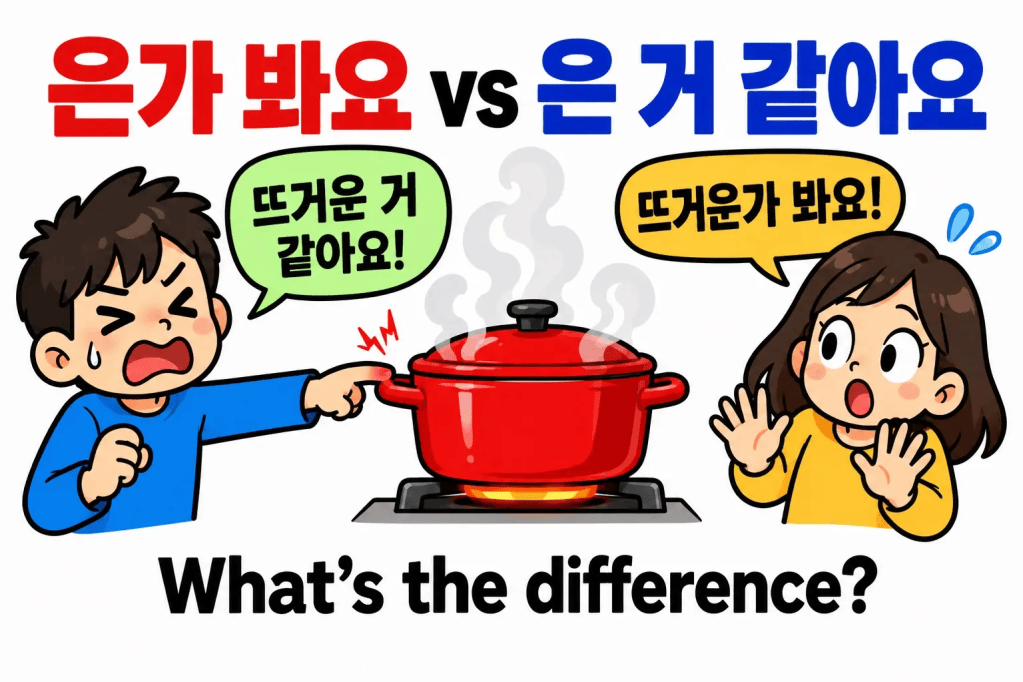
Want to keep learning? Check out the related post on -(으)ㄹ 텐데 — and see how the very same MeloMance lyrics use both patterns in just two lines. And coming soon — in Part 2, we’ll compare -나 보다 with other inference expressions like -는 것 같다, -(으)ㄹ 텐데, and -겠다. Same meaning? Not quite. 👀






Leave a Reply