
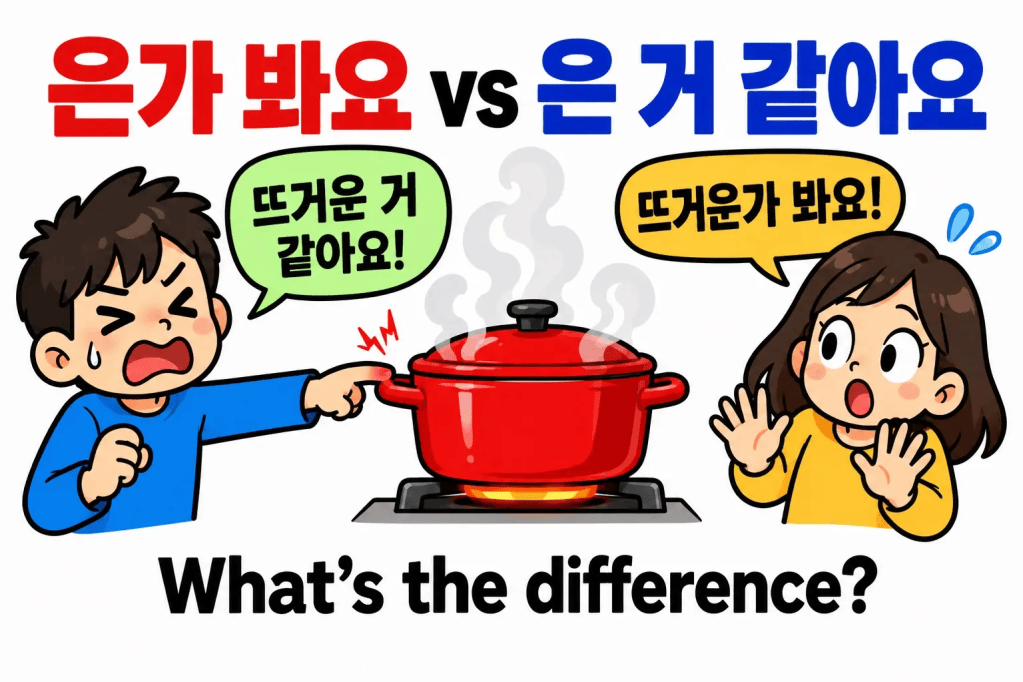
“It seems hot” — 뜨거운가 봐요 vs 뜨거운 거 같아요, 뭐가 달라요?
Korean learners often mix up -나 봐요/은가 봐요 and -은 거 같아요. They both translate to “it seems like~” or “I think~” in English — so what’s the difference? Let’s break it down with one simple situation: a hot pot. 🍲
The Situation
Imagine there’s a steaming hot pot on the table. Three people react differently:
- Person A touches the pot directly → winces in pain
- Person B watches Person A’s reaction from across the room
- Person C just sees the pot from a distance, no other clues
Each person uses a different expression — and they’re ALL correct. Here’s why.
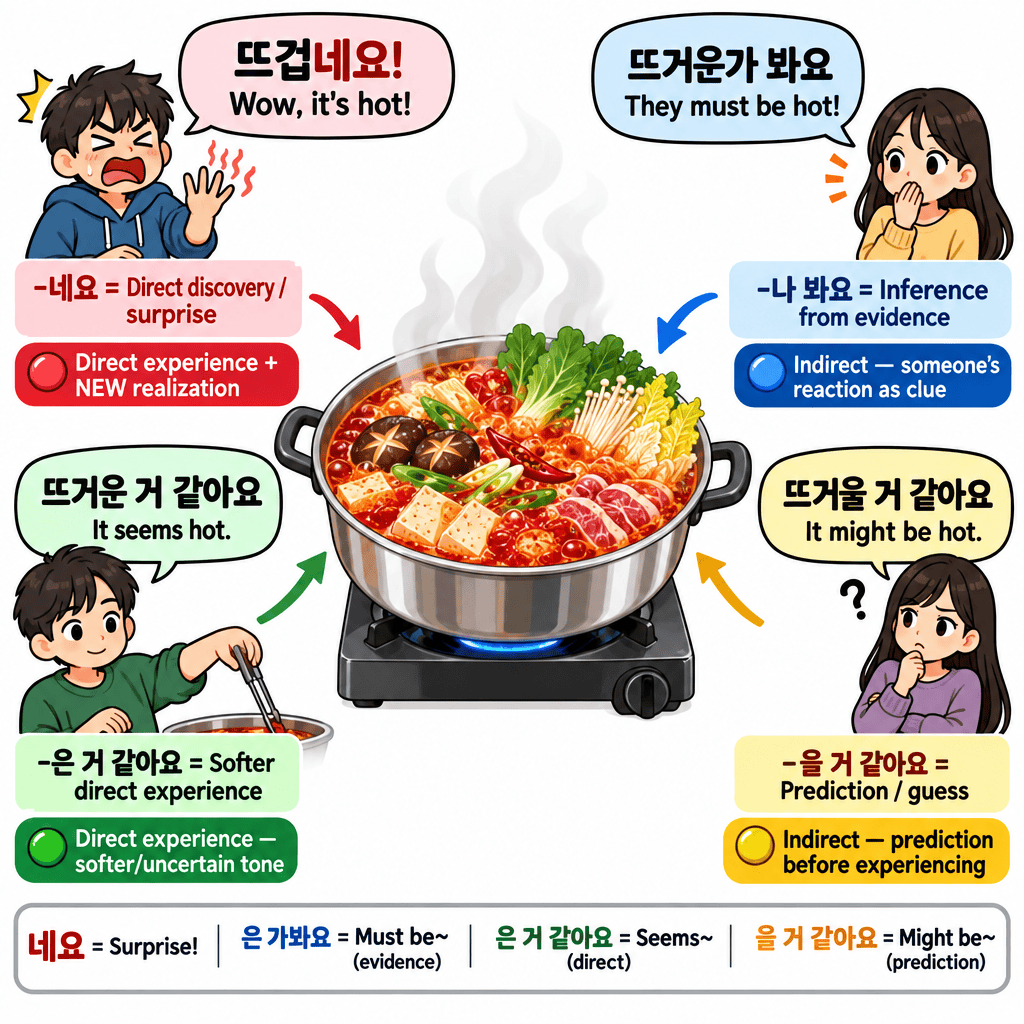
1. -네요 — “Wow, it’s hot!”
뜨겁네요!
Person A touched the pot. It’s hot. They know it’s hot — they just discovered it firsthand.
-네요 is used when you directly experience or notice something new. It carries a sense of surprise or fresh realization.
✅ Direct experience
✅ New discovery / “Aha!” moment
👉 You felt it, saw it, heard it yourself — and it’s a new realization in that moment.
2. -은가 봐요 — “It must be hot!”
뜨거운가 봐요.
Person B didn’t touch the pot. But they saw Person A wincing — that’s their clue. Based on that evidence, they conclude the pot must be hot.
-은가 봐요 is used when you make an inference based on concrete, visible evidence. You didn’t experience it yourself — but a sign, a reaction, or a clue tells you.
❌ Direct experience NOT allowed
✅ Indirect clue or evidence required
👉 You saw proof. The evidence speaks for itself.
⚠️ If YOU are the one touching the pot, you cannot say 뜨거운가 봐요. That would be like saying “I must be feeling pain” while you’re literally feeling it.
❗ Rule: -은가 봐요 Cannot Be Used in 1st Person
This is one of the most common mistakes! Because -은가 봐요 is based on observing clues from the outside, it cannot be used to describe your own feelings or states.
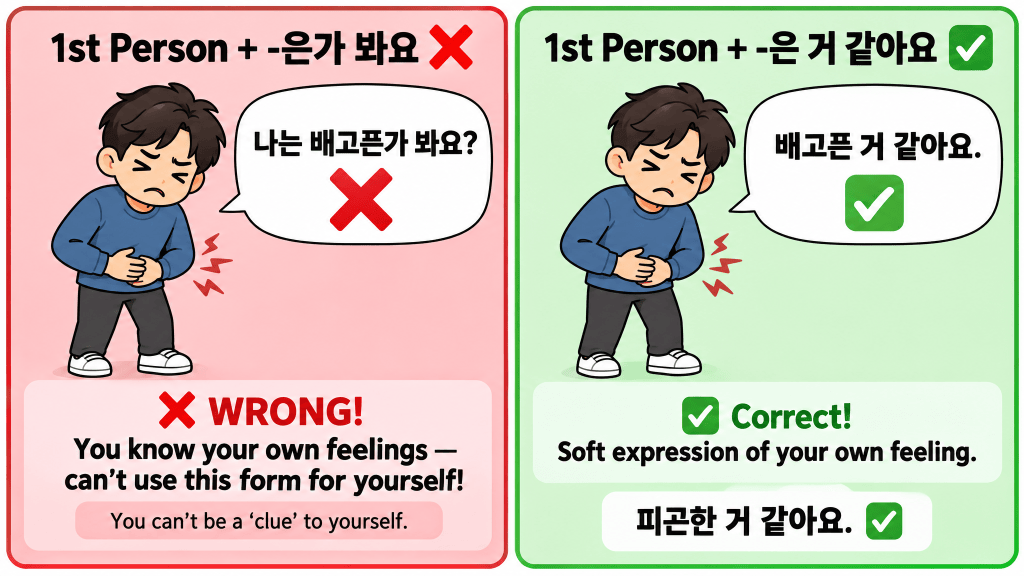
You know your own feelings — you don’t need to observe yourself as a clue!
| ❌ Incorrect | ✅ Correct |
|---|---|
| 나는 배고픈가 봐요. | 배고픈 거 같아요. |
| 나는 피곤한가 봐요. | 피곤한 거 같아요. |
| 나는 슬픈가 봐요. | 슬픈 거 같아요. |
For your own internal feelings, always use -은 거 같아요 instead.
3. -은 거 같아요 vs -을 거 같아요
Here’s where it gets interesting. -거 같아요 is the most flexible of the three.
-은 거 같아요 → “It seems hot” (present observation)
뜨거운 거 같아요.
- Person A touched it → “It seems hot.” ✅ (direct)
- Person B saw the reaction → “It seems hot.” ✅ (indirect)
Works for both direct and indirect experience. The tone is softer and more uncertain than -네요 — even when you touched it yourself, you’re expressing it as a gentle observation rather than a definite fact.
-을 거 같아요 → “It might be hot” (prediction)
뜨거울 거 같아요.
Person C is just looking at the pot. Nobody reacted. There’s steam rising. They predict it’s hot before experiencing anything directly.
-을 거 같아요 is for prediction — but note, it’s not a random guess. There’s still some basis (steam, fire, common sense). It just doesn’t require the specific concrete clue that -은가 봐요 demands.
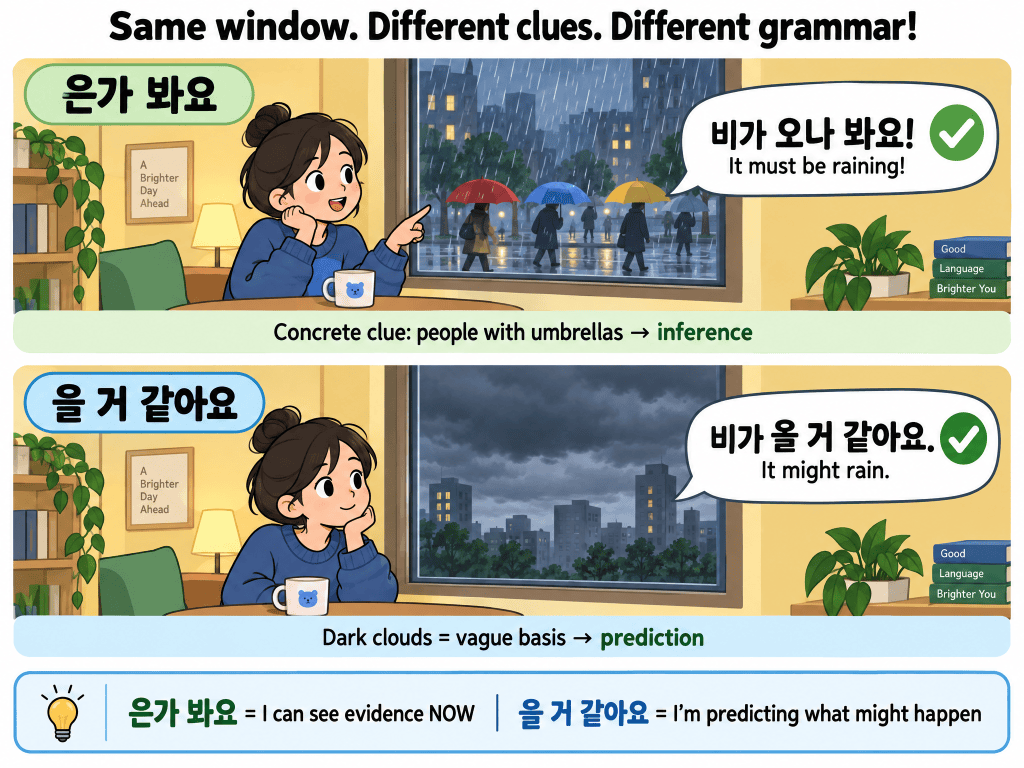
Full Comparison Table
| -네요 | -은가 봐요 | -은 거 같아요 | -을 거 같아요 | |
|---|---|---|---|---|
| English feel | Wow, it is! | It must be~ | It seems~ | It might be~ |
| Direct experience | ✅ | ❌ | ✅ | ❌ |
| 1st person feelings | ✅ | ❌ | ✅ | ✅ |
| Needs concrete clue | No | ✅ Yes | Flexible | No (vague OK) |
| Future prediction | ❌ | ❌ | ❌ | ✅ |
| Certainty level | High | Medium-high | Medium | Low |
Summary
😲 Just discovered it yourself? → -네요 (Wow, it is!)
👀 Saw a concrete clue? → -은가 봐요 (It must be~)
🤔 Soft observation — direct or indirect? → -은 거 같아요 (It seems~)
🔮 Predicting something? → -을 거 같아요 (It might be~)
Which one do you mix up the most? Leave a comment below! 👇






Leave a Reply