

🎵 Start with this song!
“네가 옆에 있으면 좋을 텐데…”
The title of this song is actually a grammar point. 😊
But before we get to 좋을 텐데, let’s understand the full picture of -(으)ㄹ 텐데 first!
1. What is -(으)ㄹ 텐데?
-(으)ㄹ 텐데 is used when you expect or assume something is likely true — often with a “so…” or “but…” feeling attached.Verb/Adjective stem + -(으)ㄹ 텐데
It comes from:
- -(으)ㄹ 터 = expectation, intention
- -인데 = “and / but / so”
Together, it means: “It’s probably the case that… so / but…”
2. Main use: Making an assumption or expectation
This is the core meaning of -(으)ㄹ 텐데.
지금쯤 배고플 텐데 밥 먹었어?
You must be hungry by now — did you eat?
그 영화 정말 재미있을 텐데 꼭 봐!
That movie must be really good — you have to watch it!
오늘 길이 막힐 텐데 일찍 출발해.
Traffic will probably be bad today — leave early.
그 카페 분위기 좋을 텐데 한번 가봐!
That café must have a nice vibe — you should check it out!
💡 Notice the structure: the speaker assumes something and then gives advice, a warning, or a follow-up thought.
3. How to conjugate
| Stem ending | Rule | Example |
|---|---|---|
| Vowel | + ㄹ 텐데 | 오다 → 올 텐데 |
| Consonant | + 을 텐데 | 먹다 → 먹을 텐데 |
| ㄹ stem | + 텐데 | 알다 → 알 텐데 |
피곤할 텐데 좀 쉬어.
You must be tired — get some rest.
시험이 어려울 텐데 열심히 공부해야겠다.
The exam will probably be hard — I should study hard.
4. Past assumption: -았/었을 텐데
To make an assumption about a past situation, use:-았/었을 텐데
어제 콘서트 정말 좋았을 텐데.
The concert must have been really great yesterday.
많이 피곤했을 텐데 고생했어.
You must have been exhausted — good work.
혼자 하기 힘들었을 텐데 잘했어!
That must have been hard to do alone — well done!
5. -(으)ㄹ 텐데 as background context
-(으)ㄹ 텐데 is also used to set up a background situation before making a request or suggestion — like saying “I know this is the case, but…”
바쁠 텐데 시간 내줘서 고마워.
I know you must be busy, but thank you for making time.
힘들 텐데 조금만 더 힘내자.
I know it’s tough, but let’s hang in there a little longer.
멀었을 텐데 와줘서 정말 고마워.
I know it was far — thank you so much for coming.
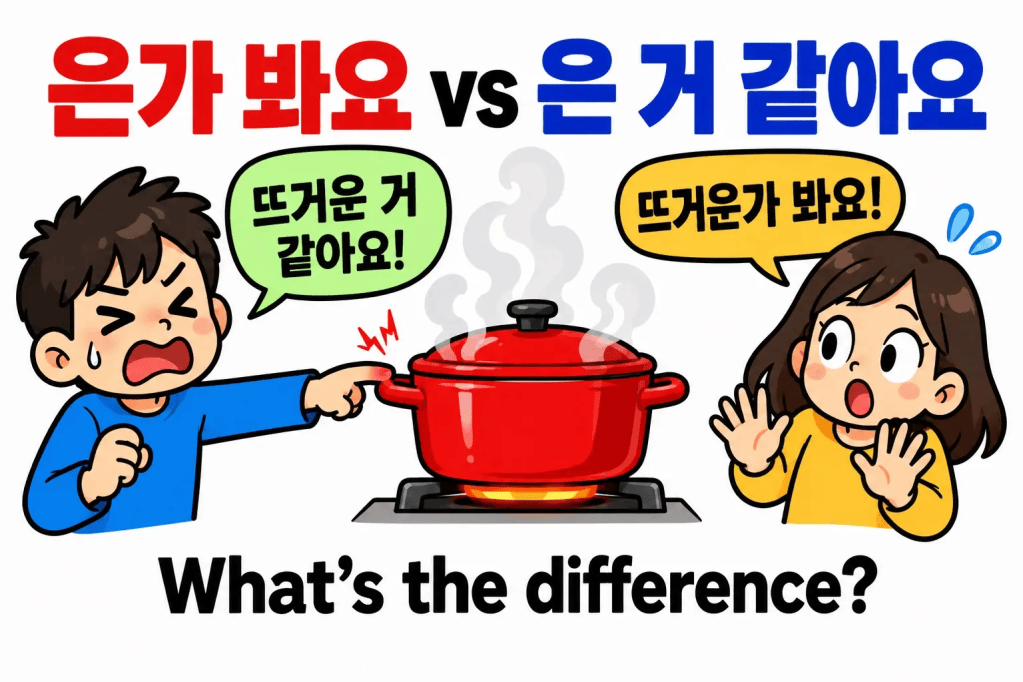
6. -(으)ㄹ 텐데 vs -(으)ㄹ 것 같은데 — What’s the difference?
Both expressions make a guess or assumption, but the confidence level and nuance are different.
| -(으)ㄹ 텐데 | -(으)ㄹ 것 같은데 | |
|---|---|---|
| Confidence | Stronger — fairly certain | Softer — less sure |
| Nuance | “It’s probably the case” | “It seems like / I think maybe” |
| Basis | Logic, context, prior knowledge | Personal impression, uncertain feeling |
Same situation, different feeling:
지금쯤 배고플 텐데 밥 먹었어?
You must be hungry by now — did you eat?
→ The speaker is fairly sure based on the time/situation.
지금쯤 배고플 것 같은데 밥 먹었어?
I think you might be hungry by now — did you eat?
→ The speaker is guessing, less certain.
그 영화 재미있을 텐데 꼭 봐!
That movie must be good — you have to watch it!
→ Confident recommendation.
그 영화 재미있을 것 같은데 한번 볼까?
That movie seems like it might be good — want to watch it?
→ A softer suggestion, less sure.
💡 Simple rule of thumb:
- -(으)ㄹ 텐데 = “It must be / It will probably be…” (confident)
- -(으)ㄹ 것 같은데 = “It seems like it might be…” (uncertain)
7. Special case: -(으)면 좋을 텐데 — Wishes 🌸
Now here’s where 좋을 텐데 becomes special.
When 좋을 텐데 connects with -(으)면, it no longer just expresses an assumption. It expresses a wish or longing — something you hope for but that isn’t (yet) reality.-(으)면 + 좋을 텐데=”I wish… / It would be nice if…”
네가 여기 있으면 좋을 텐데.
It would be nice if you were here.
시간이 더 있으면 좋을 텐데.
I wish we had more time.
같이 갈 수 있으면 좋을 텐데.
It would be nice if we could go together.
한국어를 더 잘 하면 좋을 텐데.
I wish I could speak Korean better.
This is exactly the feeling in 성시경의 〈좋을텐데〉:
“네가 옆에 있으면 좋을 텐데…” — a soft, bittersweet longing. 🎶
Compare the nuance:
| Expression | Feeling |
|---|---|
| 네가 여기 있으면 좋겠다. | Direct, casual wish |
| 네가 여기 있으면 좋을 텐데. | Wistful, bittersweet longing ✨ |
8. Regret about the past: -았/었으면 좋았을 텐데 💔
To express regret about something that didn’t happen in the past:-았/었으면 + 좋았을 텐데=”It would have been nice if…”
그때 같이 갔으면 좋았을 텐데.
It would have been nice if we had gone together then.
좀 더 일찍 만났으면 좋았을 텐데.
I wish we had met sooner.
그 말을 했으면 좋았을 텐데.
I wish I had said that.
파티에 왔으면 좋았을 텐데!
It would have been great if you had come to the party!
⚠️ Don’t mix up the tenses!
- ❌ 어제 날씨가 맑으면 좋을 텐데.
- ✅ 어제 날씨가 맑았으면 좋았을 텐데.
9. Full summary
| Pattern | Meaning | Example |
|---|---|---|
| -(으)ㄹ 텐데 | Assumption / expectation | 배고플 텐데 밥 먹었어? |
| -(으)ㄹ 것 같은데 | Soft guess / impression | 배고플 것 같은데 밥 먹었어? |
| -았/었을 텐데 | Past assumption | 힘들었을 텐데 잘했어. |
| -(으)면 좋을 텐데 | Present/future wish | 같이 가면 좋을 텐데. |
| -았/었으면 좋았을 텐데 | Past regret | 일찍 만났으면 좋았을 텐데. |
🎵 [Lalla Challenge!]
Listen to 성시경 — 좋을텐데 one more time. 🎶
Can you spot all the -(으)ㄹ 텐데 patterns in the lyrics?
And try making your own sentence:
Think of something you wish were different right now. Write it using -(으)면 좋을 텐데! 💭
Drop your answer in the comments! 👇
Happy learning with Lalla Korean! 🌸





Leave a Reply