
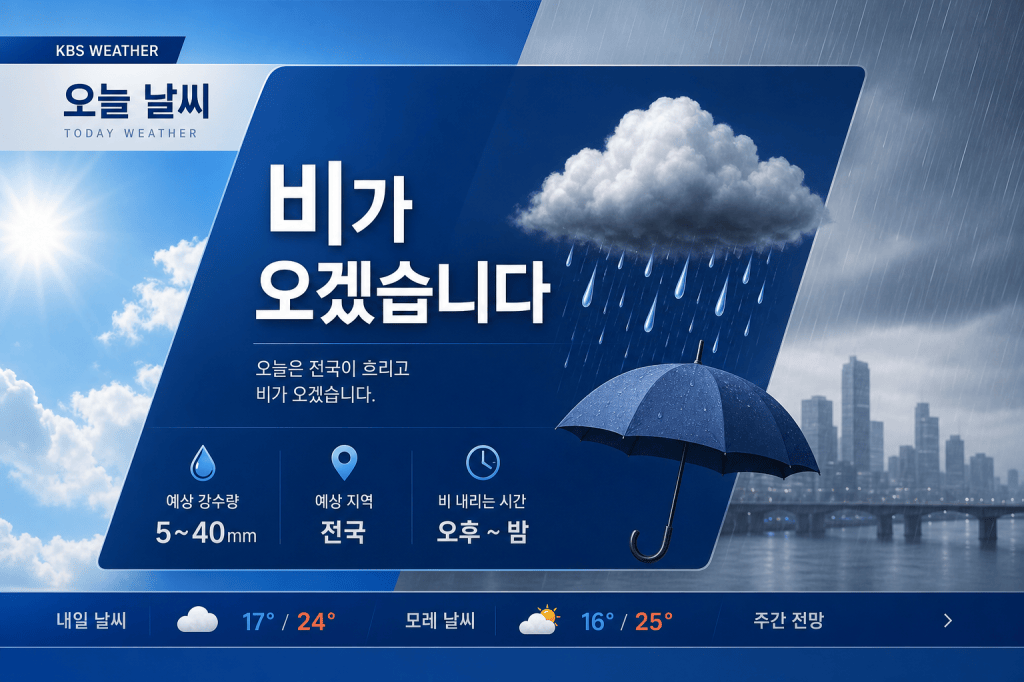
You’re watching the Korean evening news, and the forecaster says:
“내일은 비가 오겠습니다.” (It will rain tomorrow.)
Wait — does that mean the weathercaster is promising to make it rain? 😄
Not quite! To understand why, we need to look at what -겠습니다 really means.
1. What does -겠습니다 usually mean?
In English, it’s closest to “I will,” “I shall,” or “I promise to.”
While other future expressions simply describe a plan, -겠습니다 carries the weight of personal commitment. It tells the listener: “I’ve decided to do this, and I’m officially committing to it.”
So back to our weathercaster — they aren’t promising to control the weather! In formal broadcasts and news reports, -겠습니다 is used to deliver information with authority and confidence. It signals an official expectation, not a personal vow.
📺 On the news: “맑겠습니다.” → “It is officially expected to be sunny.”
☀️ With friends: “맑을 거예요.” → “I think it’ll be sunny!”
Same weather, different feel. In daily conversation, (으)ㄹ 거예요 sounds much more natural.
2. Super Simple Form (No “으” Needed!)
Here is the best part: -겠습니다 is very easy to use!
Unlike many Korean grammar points that require you to add -(으)- when there is a final consonant, -겠습니다 never changes. You just stick it directly to the end of any verb stem.
| Verb Type | Stem | Final Form | English Meaning |
|---|---|---|---|
| No Consonant | 가- | 가겠습니다 | I will go. |
| With Consonant | 먹- | 먹겠습니다 | I will eat. |
| ‘ㄹ’ Consonant | 만들- | 만들겠습니다 | I will make. |
| Irregular ‘ㅂ’ | 돕- | 돕겠습니다 | I will help. |
⚠️ Common Mistake: Don’t say “먹으겠습니다” (X).
Even with a consonant, it’s always just -겠습니다! (O)
3. When should you use it?
Because -겠습니다 expresses firm will or intention, it fits naturally in formal or resolute situations:
- At work: “I will check the report.” → 확인하겠습니다.
- In class: “The lesson will begin now.” → 시작하겠습니다.
- Making a resolution: “I will study harder!” → 열심히 하겠습니다.
- Polite acknowledgment: “Understood.” → 알겠습니다.
4. How is it different from -(으)ㄹ게요 or -(으)ㄹ 거예요?
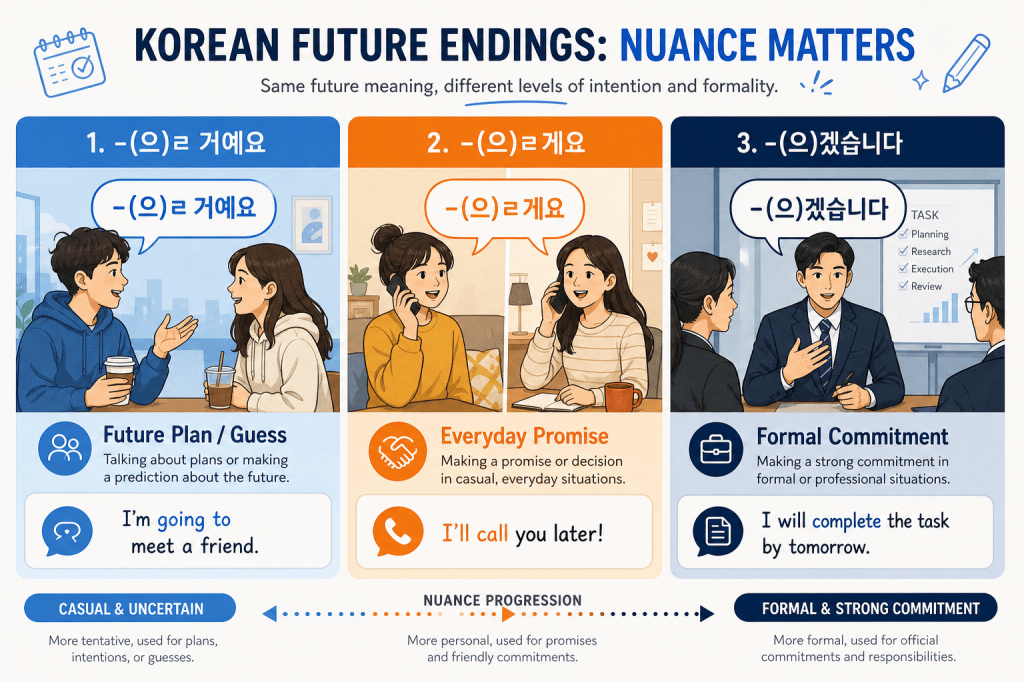
5. Remember: It’s usually about “ME”
Because it’s about intention, you mostly use it for your own actions (I/We).
- ✅ 제가 하겠습니다. (I will do it.)
- ❌ 친구가 하겠습니다. (My friend will do it.) — Use “갈 거예요” for others.
Note: Weathercasters use it for the weather in news reports (“비가 오겠습니다”), but in daily life, talk about the weather with “(으)ㄹ 거예요”!
6. Top 5 “Must-Know” Phrases
- 알겠습니다. (Got it! / I’ll keep that in mind.)
- 열심히 하겠습니다. (I’ll work hard / I’ll do my best.)
- 잘 먹겠습니다! (I will eat well — said before a meal.)
- 처음 뵙겠습니다. (Nice to meet you — literally: I see you for the first time.)
- 최선을 다하겠습니다. (I will do my best.)

[Lalla Challenge! 🎵]
Imagine you are at a Korean company. Your boss asks you to finish a task by tomorrow. How would you say “I will finish it by tomorrow”?
(Hint: To finish = 끝내다)
Write your answer in the comments! 👇
Happy learning with Lalla Korean! 🌸






Leave a Reply